
Introduction
The international food export landscape experienced a definitive paradigm shift during 2025. Historically characterized as a static exercise in certification and retrospective audit preparation, the sector has transitioned into a dynamic environment requiring holistic system capability and integrated operational governance.
As global trade navigates the second quarter of 2026, the strategic focus has evolved beyond merely obtaining a “passport to export.” Instead, current market demands necessitate a state of perpetual readiness facilitated by robust, data-driven internal frameworks. Such a transition ensures that compliance is not a periodic event but a continuous attribute of the operational workflow.
A Retrospective of International Export Programs in 2025
In 2025, the Netherlands functioned as a pivotal nexus for multilateral knowledge dissemination. Diverse international delegations engaged in intensive capacity-building initiatives that effectively recalibrated the synergy between sovereign regulatory frameworks and private-sector operational execution. Such strategic exchanges fostered a practical convergence between public-sector oversight and private-sector compliance, a relationship that serves as the foundation for the complex trade requirements encountered in 2026.
Cambodia: Integrating HACCP into daily practice
The CAPRED Food Export Program focused on bridging the gap between theoretical HACCP principles and practical application. By early 2026, the emphasis for Cambodian exporters evolved from basic awareness toward the full digitization of food safety records to meet stringent European transparency requirements.
Rwanda: Building national ecosystems
The Government-to-Business (G2B) approach highlighted that export success is a systemic outcome rather than an individual achievement. The focus remains on establishing shared infrastructure that supports small and medium-sized enterprises (SMEs) in achieving compliance at scale.
Saudi Arabia: Industrial scale and real-time monitoring
Activities in 2025 explored how high-volume industrial operations can move beyond periodic audits. The implementation of real-time assurance systems has become a priority in 2026, allowing for data-driven decision-making in complex supply chains.
Vietnam: Strategic alignment and policy integration
The embassy-level workshops emphasized the necessity of aligning national export strategies with European expectations. Such alignment ensures that policy frameworks actively support the operational needs of food producers.
Ukraine: Logistics and Organic Integrity
The Market Orientation Mission for organic cereals demonstrated the critical link between safety standards and logistical infrastructure. These efforts provided Ukrainian exporters with a deeper understanding of European Union processing and storage requirements.
Ghana: Digital Knowledge Transfer and Scaling Awareness
The Export Bridge Webinar Program utilized digital platforms to disseminate technical knowledge efficiently. The reusable nature of these materials has allowed for continuous capacity building within the Ghanaian food sector well into 2026.
Integration of EUDR into Global Food Export Systems
A defining attribute of the 2026 export landscape is the rigorous implementation of the EU Deforestation Regulation (EUDR). Compliance mandates that specific commodities—including cocoa, coffee, palm oil, rubber, and soy—originate from land not subject to deforestation or forest degradation after the December 31, 2020 cutoff. The recent April 2026 Simplification Package has further refined these obligations, emphasizing the necessity for precise geolocation data and polygon mapping within the TRACES NT portal.
Consequently, the transition to a system-based assurance model has evolved from a competitive differentiator into a critical regulatory necessity. Adopting a data-driven framework is now essential for navigating intensified transparency standards and securing continued access to the European market. Rather than treating environmental due diligence as an isolated administrative task, the current 2026 environment requires these requirements to be embedded within the daily operational workflow. Such integration ensures that every shipment is backed by a verified Due Diligence Statement (DDS), effectively bridging the gap between field-level production and international market entry.
To read more about the EUDR:
The Emerging Food Export Paradigm: From Compliance to System Capability
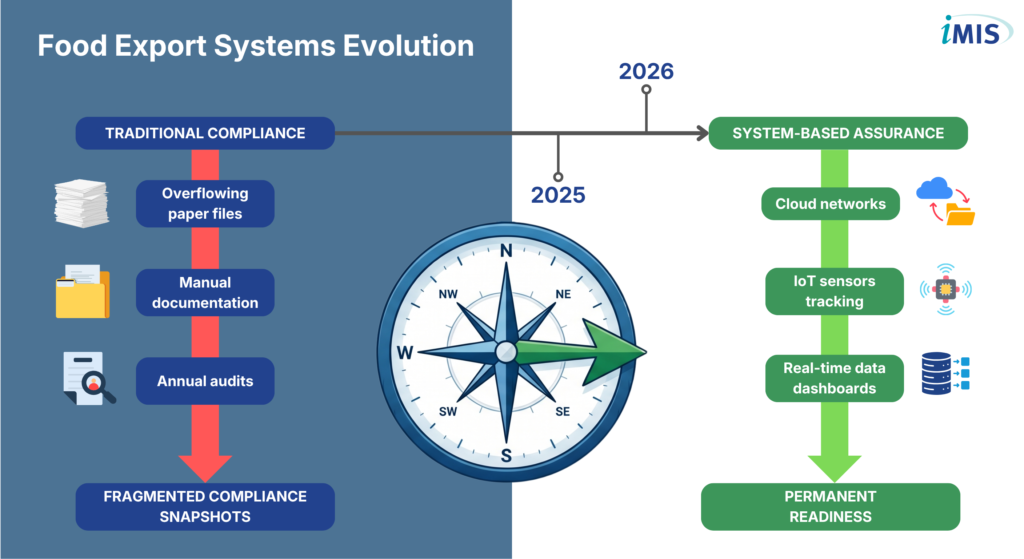
While certification remains an essential baseline, it no longer provides a sufficient guarantee for sustained market access. Traditional audits are inherently retrospective and frequently fail to reflect daily operational realities. Consequently, 2026 is defined by an accelerated shift toward system-based thinking.
Rather than preparing for periodic inspections, organizations now engineer processes for reliability under actual conditions. Such integration involves embedding technical expertise into standardized workflows and utilizing automated verification. Transitioning from a reactive posture to continuous proactive control is currently the only viable path to meeting the rigorous, real-time data demands of the EUDR.
Future Directions for 2026 and Beyond
As the industry looks toward the remainder of 2026, several key trends are defining the future of food export:
- Interoperable data systems: There is an increasing demand for food exports systems that can seamlessly share safety data across borders, reducing the administrative burden on exporters.
- Sustainability-safety integration: Regulatory bodies are increasingly linking food safety compliance with environmental and social governance (ESG) metrics.
- Predictive risk management: The use of historical data to predict potential safety breaches before they occur is becoming a standard component of advanced export systems.
Food Export Compliance vs. Control: The 2026 Difference
The table below provides a comparative analysis of the fundamental paradigm shift, contrasting traditional retrospective compliance with modern, system-based assurance:
| Traditional Compliance (Pre-2025) | System-Based Control (2026) |
| Retrospective (looking at what happened) | Proactive (monitoring what is happening) |
| Document-heavy and manual | Data-driven and automated |
| Focused on the “audit day” | Focused on “every day” |
| Isolated company effort | Integrated ecosystem approach |
The QAssurance Food Export Program: Strategic Support for Global Trade
The QAssurance Food Export Program empowers international producers to secure European market access by transitioning from manual compliance to System-Based Assurance. Utilizing the iMIS Food platform, the program converts fragmented records into a unified digital framework, ensuring perpetual audit readiness for delegations such as those from Cambodia, Ukraine, and Ghana.
The mission centers on democratizing food safety excellence through digital resilience. By embedding technical expertise directly into automated workflows, QAssurance facilitates inclusive global trade. Such an approach ensures that geographical location is no longer a barrier to meeting the rigorous transparency and environmental standards of 2026. Through this methodology, the program replaces the instability of periodic inspections with the security of a verified, continuous system.
Conclusion
The developments of 2025 confirmed that export success is defined by the ability to demonstrate consistent and transparent control. Countries and organizations that prioritize system capability and continuous verification are now better positioned to navigate the complexities of the global market. The transition toward system-based assurance represents a fundamental move toward a more resilient and reliable global food supply chain.
Sources
- Organic Initiative (2025). Trade Mission to the Netherlands: Strengthening Organic Exports.
- Netherlands Enterprise Agency (2026). G2B Programs and Export Capability Building.
Related articles to Food Export Evolution: The Global Shift Toward System-Based Assurance
Many customers and visitors to this page 'Food Export Evolution: The Global Shift Toward System-Based Assurance ' also viewed the articles and manuals listed below: