
The European Union Deforestation Regulation (EUDR), formally known as Regulation (EU) 2023/1115, represents a significant legislative effort to minimize the contribution of the European market to global deforestation and forest degradation. Such legislation mandates that specific commodities—namely cattle, cocoa, coffee, oil palm, rubber, soya, and wood—as well as derived products like chocolate or furniture, must be “deforestation-free” to be placed on or exported from the Union market. Beyond environmental criteria, products must be produced in accordance with the relevant legislation of the country of origin.
Latest Implementation Developments
Recent developments have introduced significant changes to the compliance roadmap. Following the adoption of Regulation (EU) 2025/2650 in December 2025, the application dates were officially postponed to allow stakeholders more time for technical preparation. Currently, the following deadlines apply:
- Large And Medium-Sized Operators: 30 December 2026.
- Micro And Small Enterprises (SMEs): 30 June 2027
Beyond the timeline extension, the European Commission has refined the definitions of market participants:
- A new category, “downstream operators“, has been introduced to streamline responsibilities within the supply chain.
- Such entities, which process or export products already covered by an existing Due Diligence Statement (DDS), are now primarily responsible for collecting and retaining the reference number of the initial declaration rather than resubmitting the entire due diligence process.
- As of April 2026, the Commission is finalizing its “simplification review” to identify further technical adjustments that could ease the administrative burden on smaller producers.
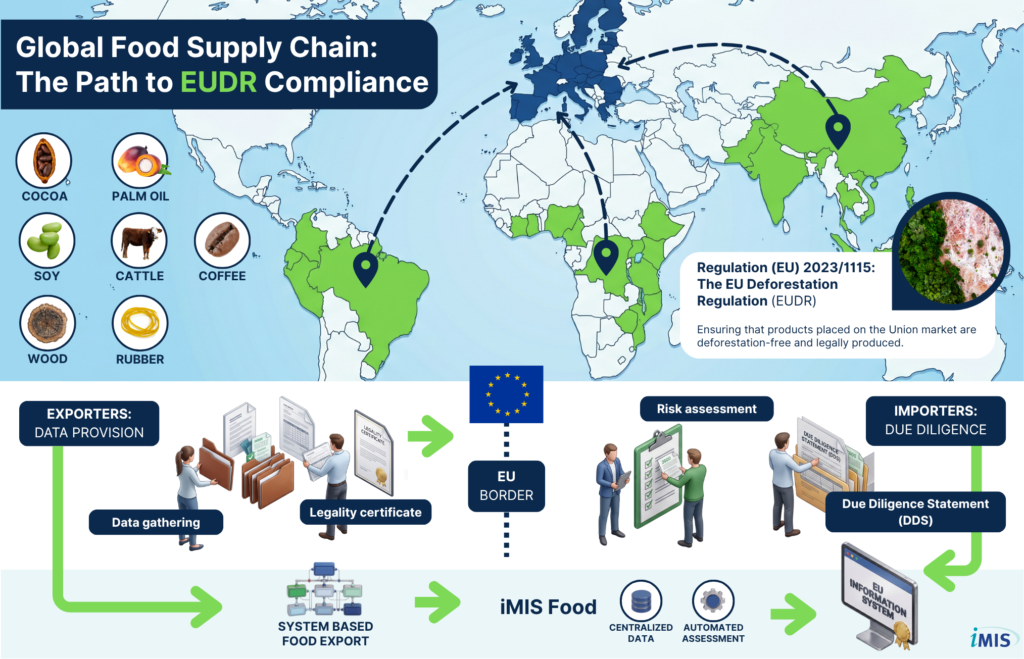
Essential EUDR Requirements for Importers into the EU
For entities importing relevant commodities into the European Union, the role of an “operator” carries significant legal weight. Importers are responsible for exercising due diligence to ensure that products meet all regulatory requirements before being placed on the market. Such a process involves three primary steps:
- Information collection: Gathering specific evidence, including geolocation coordinates for every plot of land where the raw materials were produced.
- Risk assessment: Evaluating the risk of non-compliance based on the “benchmarking system,” which categorizes countries as low, standard, or high risk.
- Risk mitigation: Implementing measures to minimize identified risks, such as additional audits or supplier training.
- Upon completion of these steps, importers must submit a Due Diligence Statement (DDS) via the official Information System. Placing products on the market without a valid reference number for such a statement constitutes a violation of the regulation.
Essential EUDR Requirements for Exporters into the EU
Producers and exporters located outside the European Union must adapt their operations to facilitate the compliance of their European partners. While the legal obligation to submit a Due Diligence Statement (DDS) often falls on the first operator within the Union, the burden of data provision rests heavily on the exporter. Such a dynamic requires specific actions to ensure market continuity:
- Data integrity: Failure to provide precise geolocation data and evidence of legal production will likely result in the exclusion of products from the Union market.
- Traceability frameworks: Traceability serves as the cornerstone of such a relationship; exporters are encouraged to integrate their documentation into a transparent system that aligns with European standards.
- Structural guidance: For a deeper understanding of how to structure such operations, readers may refer to our latest article about food export system based, which details the technical frameworks necessary for maintaining market access.
- Risk assessment readiness: Establishing such systems ensures that data regarding production dates and land legality is readily available for European importers during their risk assessment phase.
Legal Steps for EUDR Compliance
To ensure market access, companies must adhere to a structured legal process. The following steps are mandatory for any operator:
| Step | For importers (into the EU) | For exporters (out of the EU) |
| 1. Information | Collect geolocation coordinates and proof of legal production from the global supplier. | Verify that the raw materials used in production were compliant when they entered your facility. |
| 2. Assessment | Evaluate the risk of deforestation based on the country’s “benchmarking” (Low, Standard, or High risk). | Ensure the chain of custody remains unbroken and that no non-compliant material was mixed in. |
| 3. Mitigation | If risk is not “negligible,” perform audits or satellite monitoring to prove compliance. | Maintain records for 5 years showing that the exported batch is tied to a valid EUDR reference number. |
| 4. Submission | Register in TRACES and submit the DDS to get a unique Reference Number. | Register in TRACES and submit a DDS for the export shipment using previous reference numbers. |
Strategic Recommendations for Future EUDR Preparedness
Preparing for the upcoming deadlines requires a proactive approach to supply chain management. Organizations should prioritize the following actions:
- Mapping Supply Chains: Identifying every actor in the upstream supply chain to ensure that geolocation data is accessible for every batch of product.
- Verifying Legality: Confirming that production adheres to the laws of the country of origin, specifically regarding land-use rights and environmental protections.
- Adopting Digital Solutions: Moving away from manual record-keeping to digital platforms that can store and transmit complex data sets efficiently.
Utilizing the current transition period to conduct gap analyses will prevent operational bottlenecks when the regulation becomes fully enforceable.
Utilizing iMIS Food for EUDR Compliance
Navigating the complexities of the EUDR necessitates a centralized and reliable documentation system. iMIS Food offers a robust solution for food safety consultants and quality managers to manage these new requirements effectively. The platform facilitates the storage of supplier declarations, geolocation files, and legality certificates in a single, accessible location.
By integrating EUDR criteria into the iMIS Food risk assessment modules, companies can automate the evaluation of their raw materials. The system provides clear overviews of supply chain transparency, allowing operators to identify potential risks long before products reach the Union border. Such integration ensures that the due diligence process is not only compliant but also optimized for daily operations.
Conclusion
The EUDR is a transformative regulation that demands a fundamental shift in how global supply chains operate. Although the recent postponement provides additional time, the core requirements remain unchanged. Importers and exporters who invest in traceability and robust data management systems today will be best positioned to navigate the regulatory landscape of 2026 and beyond.
Sources
- European Commission. (2023). Regulation (EU) 2023/1115 on the making available on the Union market and the export from the Union of certain commodities and products associated with deforestation and forest degradation.
- Official Journal of the European Union. (2025). Regulation (EU) 2025/2650 amending Regulation (EU) 2023/1115 as regards the dates of application.
- European Commission. (2026). Implementation Guidance and Frequently Asked Questions on the EU Deforestation Regulation.
- QAssurance. (2026). Internal Knowledge Database: iMIS Food Compliance Frameworks.
Related articles to The EUDR Compliance Guide 2026: Latest Updates and Requirements
Many customers and visitors to this page 'The EUDR Compliance Guide 2026: Latest Updates and Requirements' also viewed the articles and manuals listed below: