
Integrating artificial intelligence into food safety systems enhances supply chain management, predicts chemical hazards, and streamlines risk assessments. To govern these rapidly advancing technologies, the European Union introduced Regulation (EU) 2024/1689, commonly known as the Artificial Intelligence Act.
TThis analysis explores how the legal framework establishes global precedents for algorithmic transparency and digital governance. The text details the phased implementation timeline, outlining critical compliance deadlines that food enterprises must meet over the coming years. Furthermore, the discussion examines how current statutory classifications exclude parts of the agrifood sector, contrasting the legislation with existing cybersecurity directives.
To bridge this operational gap, the narrative provides an actionable strategy for quality managers to audit digital hazard controls effectively. Finally, the review highlights how adaptive compliance software like iMIS Food enables companies to foresee evolving food safety standards and maintain continuous regulatory alignment.
What is The EU AI Act?
Regulation (EU) 2024/1689 represents the first binding global framework established to govern algorithmic system development and market entry. The legislation introduces uniform safety regulations across the entire European Union single market to ensure responsible innovation.
The primary objective focuses on guaranteeing that deployed models remain safe, transparent, and non-discriminatory while fully respecting fundamental rights. To achieve this goal, the framework balances technological advancement against human safety by utilizing a tiered risk approach. Consequently, legal obligations for an enterprise remain directly proportional to the potential harm the technology poses to society.
Timeline for Implementation
The European Commission structured a phased rollout for Regulation (EU) 2024/1689 to allow enterprises sufficient time to align their digital frameworks with the new requirements. The binding compliance milestones apply progressively across the following timeline:
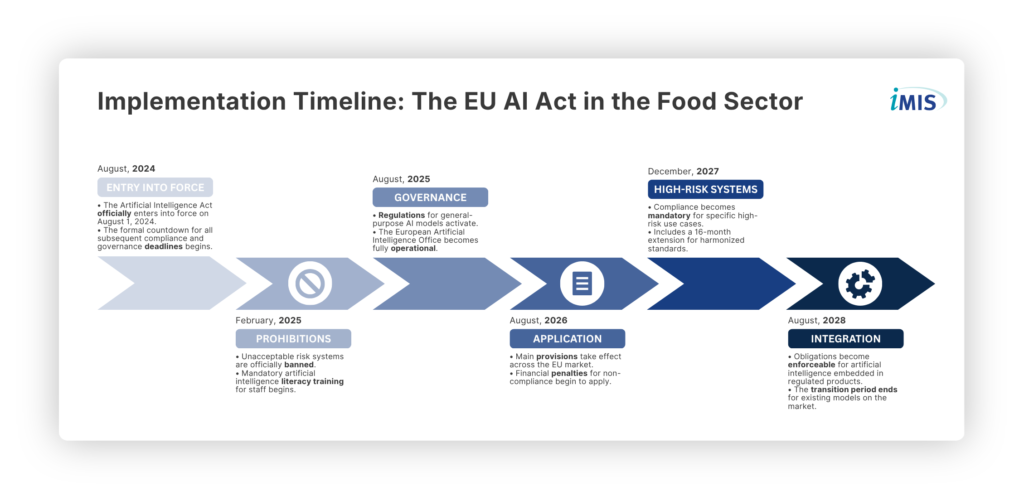
- August 1, 2024 (entry into force): The Artificial Intelligence Act officially enters into force, initiating the formal transitional countdown.
- February 2, 2025 (prohibitions and literacy): Enforceable bans target unacceptable risks, and companies must launch mandatory AI literacy programs.
- August 2, 2025 (governance and general-purpose AI): Governance frameworks for general-purpose models apply as the European AI Office becomes operational.
- August 2, 2026 (general application): The primary framework activates across the single market, introducing strict enforcement and substantial financial penalties.
- December 2, 2027 (stand-alone high-risk use cases): Strict compliance obligations become mandatory for independent, high-risk software listed under Annex III.
- August 2, 2028 (product-integrated high-risk systems): Final enforcement activates for artificial intelligence embedded as physical safety components within heavily regulated machinery.
The Regulatory Framework And General Implications For Food Safety
The Artificial Intelligence Act establishes a comprehensive framework that governs algorithmic applications based on a four-tier risk classification system: unacceptable risks, high risks, limited risks, and minimal risks. While the regulation focuses primarily on safeguarding fundamental human rights, health, and democratic values, its structural enforcement significantly influences the administrative and analytical tools used in the domain of food safety. Public deployers and regulatory bodies face stringent requirements; for instance, Articles 26 and 27 require formal fundamental rights impact assessments when public authorities deploy algorithmic systems.
The Role Of The European Food Safety Authority
Concurrently, European regulatory authorities are driving a major digital transition to integrate predictive modeling into consumer health protection. The European Food Safety Authority is actively managing initiatives to incorporate advanced algorithmic methodologies into the evidence management phase of its internal risk assessment protocols. By collaborating with international scientific entities like the Evidence-Based Toxicology Collaboration, the European Food Safety Authority aims to harness big data and New Approach Methodologies. These collaborative projects leverage systematic evidence synthesis and computational models to generate reliable, animal-free toxicity predictions, fundamentally modernizing the scientific foundation of European chemical food safety evaluation.
The Impact on the Food Industry
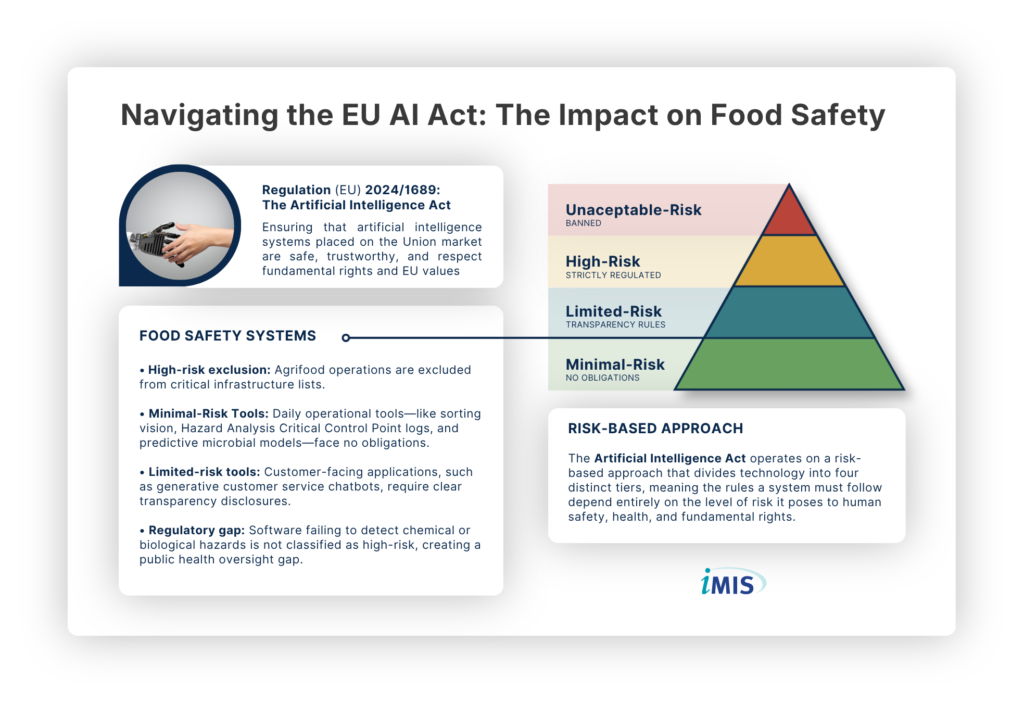
A critical element of the legislation is its exclusion of the agrifood sector from the high-risk critical infrastructure categories in Annex III. This omission creates a distinct regulatory gap compared to cybersecurity frameworks like the NIS2 Directive. The NIS2 Directive explicitly mandates strict compliance for food distribution and manufacturing entities.
Consequently, most digital tools utilized for daily food safety operations fall under the minimal-risk tier. Automated Hazard Analysis Critical Control Point documentation, computer-vision sorting, and predictive microbial software remain exempt from extensive compliance burdens.
Exceptions apply only if an artificial intelligence model operates as an embedded safety component in heavy machinery. Systems used for employee biometric evaluation also elevate the software to the high-risk category. Meanwhile, customer-facing tools like generative chatbots or nutritional recommendation engines are classified as limited-risk, requiring clear transparency disclosures.
Operational Action Plan: Preparing for Food Safety Compliance
The quality assurance landscape is shifting from manual, repetitive checking to an automated, value-driven architecture. To maintain alignment with upcoming European deadlines and manage digital food safety compliance proactively, industry leaders should adopt these steps:
- Execute a food safety technology inventory: Map all computational models, automated sorters, and supplier verification programs used to track biological or chemical hazards.
- Audit food safety risk tiers: Cross-reference all logged digital tools against the legislative criteria to verify if any system accidentally triggers a high-risk classification.
- Enforce food safety data governance: Implement rigorous data quality controls to ensure training datasets are accurate and secure, as biased data directly compromises hazard detection.
- Establish food safety human oversight: Train quality professionals to supervise automated systems, ensuring critical data interpretations regarding contamination alerts always undergo human scientific review.
Practical Example: Applying the Action Plan to Food Safety Sorting Lines
To visualize this process, consider a processing facility introducing a camera-based vision system that uses machine learning to detect external mold on incoming raw ingredients.
- Inventory: The quality manager logs the new camera-sorting system into the corporate digital register. Documenting the software vendor, the algorithmic model, and its role in preventing contaminated raw materials from entering production is crucial.
- Audit: The compliance team evaluates the sorting system against the risk pyramid. Since the software monitors ingredient quality internally and does not track employee biometrics or control heavy mechanical hardware, it is classified under the minimal-risk tier.
- Governance: The technical team reviews the training data used to teach the algorithm what “mold” looks like. The goal is expanding the dataset to include thousands of diverse, validated historical images.
- Oversight: The facility sets a protocol for when the system flags a sudden 15% spike in defects. Instead of letting the machine automatically reject entire vendor shipments, a qualified technician should physically inspect the batch.
Future Horizons And Proactive Compliance Management
The application of artificial intelligence in food safety remains in its infancy. Despite the technology is poised to revolutionize proactive hazard detection and regulatory compliance. As digital frameworks mature, policymakers may classify food supply chains as critical infrastructure, raising compliance rules for agrifood algorithms. Until then, food professionals must advocate for transparent, evidence-based technology to protect public health during these legal shifts.
Foreseeing Regulatory Updates With iMIS Food
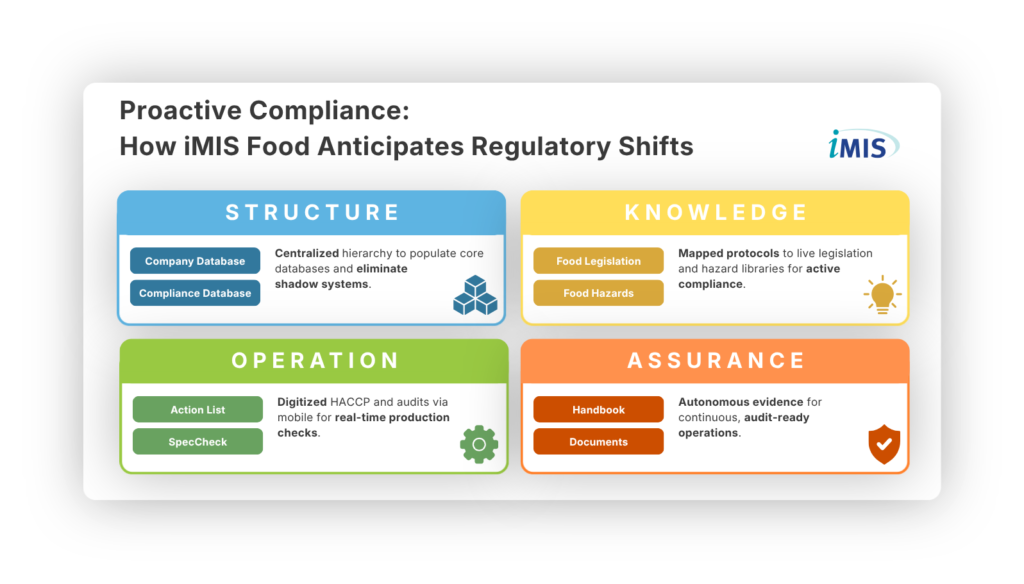
Navigating this fluid legal landscape requires agile quality management structures. The iMIS Food platform serves as an adaptive regulatory operating system that enables food enterprises to anticipate, interpret, and implement emerging digital and legal modifications seamlessly. The infrastructure supports future-ready compliance protocols through several automated mechanisms:
- Unified hazard control integration: Shifted frameworks and hazard profiles link automatically to Hazard Analysis Critical Control Point documentation, quality manuals, and audit rounds. This alignment prevents fragmented data systems and ensures factory verifications comply with current European laws.
- Real-time content and software updates: The platform uses an automated framework to deploy immediate European Union food legislation and quality standard updates directly. This central delivery ensures compliance documentation and hazard libraries adapt before regulatory deadlines take effect.
- The horizon compliance portal: Operating on a continuous feedback loop (Sense, Interpret, Decide, Act), the system monitors emerging public health updates. This allows quality teams to track prospective algorithm risk reclassifications long before enforcement criteria become mandatory.
Stay Connected: Join our Newsletter!
Ready to learn more? Subscribe to our newsletter for the latest updates, tips, and exclusive content delivered straight to your inbox!
Sources
- Grbic, L. V. (2026). The Impact of the EU AI Act on the Use of AI-Powered Chatbots. New York State Bar Association.
- Lopez, M. A. (2026). Artificial Intelligence in Food Safety: A Tertiary Study.
- Tajkarimi, M. (2020). Food Safety and Quality Data Management Using Artificial Intelligence. Food Protection Trends, 40(6), 464. https://doi.org/10.4315/1541-9576-40.6.464
- Val, I. L. (2025). The EU AI Act and the Food System: How the European Union Ai Act Applies to Agrifood. European Journal of Risk Regulation.
Related articles to The EU AI Act and Food Safety: Compliance Guide
Many customers and visitors to this page 'The EU AI Act and Food Safety: Compliance Guide' also viewed the articles and manuals listed below: