
Introduction
The central theme for food safety in 2026 is connection. Navigating the year requires fully integrated data, supply chains, and consumer values. Digitizing safety processes transforms risks—like weather patterns and chemical regulations—into opportunities for greater efficiency and consumer trust.
The era of merely reacting to regulations is over. Professionals must build systems that are resilient, fully traceable, and future-proof. This involves harnessing artificial intelligence and avoiding legacy contaminants. The following drivers and five key trends outline the definitive shifts that will redefine product quality and consumer trust in 2026.
The Drivers of “Food Safety Shift”
Understanding the underlying forces is essential before examining specific movements. Several factors are reshaping the industry and influencing the food safety trends 2026 will see:
- The circular economy push: New legislation is forcing sustainability data—like recyclability and carbon footprint—to travel directly with the product.
- Climate volatility: Extreme weather patterns are altering agricultural risk profiles, creating new pathogen and mycotoxin zones in regions previously considered safe.
- Chemical scrutiny: Regulatory agencies are tightening restrictions on packaging materials and process contaminants, aiming for a “toxic-free” environment.
- The “clean & clear” consumer: There is growing scrutiny on “Ultra-Processed Foods” (UPF). Consumers and regulators alike are demanding shorter, more understandable ingredient lists.
- Digital acceleration: The transition from paper-based audits to real-time, data-driven food safety systems is becoming a license to operate.
Top 5 Food Safety Trends for 2026
The food industry is entering a phase of rapid digital and environmental adaptation. Compliance now requires more than just meeting standards; it demands total transparency and resilience against climate risks. Operational strategies must shift from reactive problem-solving to proactive data management. The following list outlines the five critical trends defining the sector in 2026.
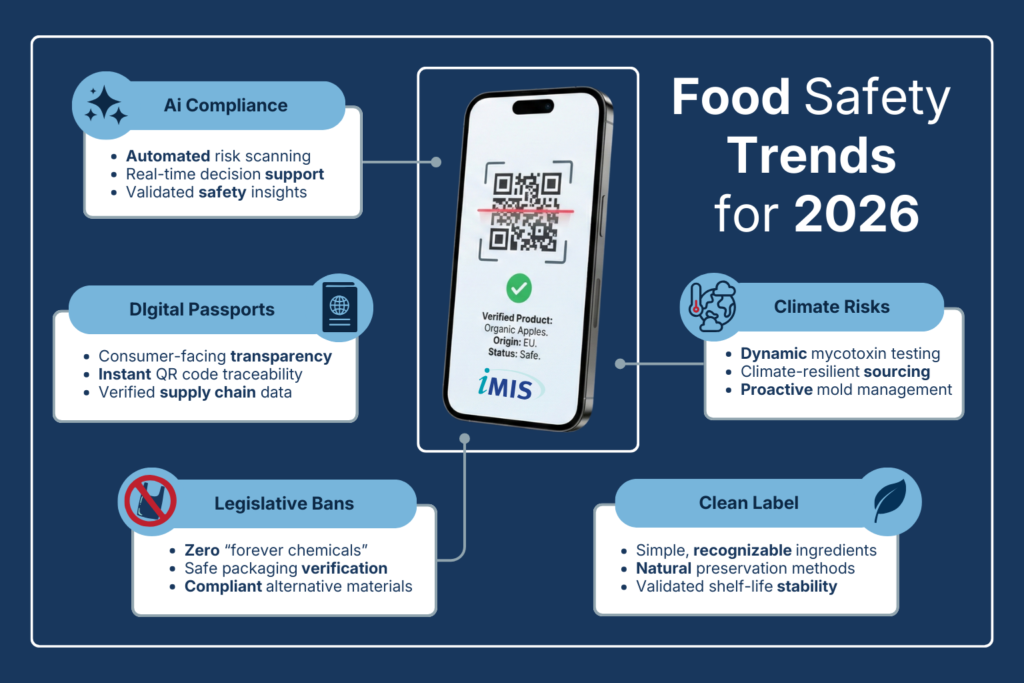
1. AI as the Digital Food Safety Compliance Brain
Artificial Intelligence is no longer just a buzzword; it is a standard tool for food safety management. With the sheer volume of global regulations, manual tracking is nearly impossible. Companies are increasingly adopting smart software that scans legislative updates and safety alerts daily, automatically cross-referencing data with recipes and suppliers to identify relevant risks efficiently.
Why it matters: This technology saves significant time by filtering out irrelevant information. Quality Managers can focus on decision-making rather than data collection.
Points of attention:
- Automated decisions require validation before implementation.
- Data accuracy is critical because incorrect input leads to flawed risk assessments.
- Staff must understand how to interpret AI-driven insights.
2. The Digital Product Passport
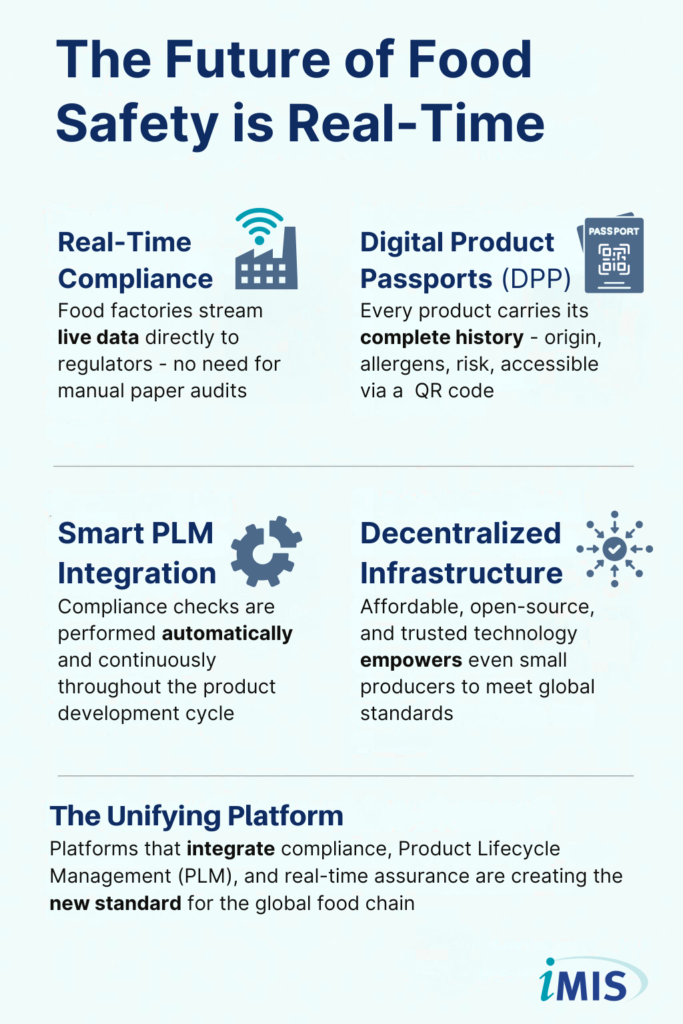
Traceability is evolving from internal tracking to full consumer transparency. The goal is a complete product history accessible via smartphone. In 2026, the use of Digital Product Passports will expand, with products carrying QR codes that instantly display origin, allergens, and environmental impact data.
Why it matters: Retailers and consumers expect instant access to product information. Companies unable to share this data digitally risk losing market share to more transparent competitors.
Points of attention:
- Data from different departments like quality and sales must be integrated into a single system.
- Suppliers must be capable of providing digital data instead of static PDF documents.
- Global standards like GS1 should be adopted for compatibility.
3. Strict Legislative Food Safety Bans (PFAS)
Regulatory bodies are cracking down on PFAS in food packaging, traditionally used for grease resistance in items like pizza boxes. With strict bans emerging across Europe, many retailers are removing these materials from their supply chains ahead of official deadlines.
Why it matters: Packaging containing these chemicals poses a risk of recalls and reputational damage. Compliance is becoming a non-negotiable requirement for market entry.
Points of attention:
- Independent verification of packaging materials is essential.
- Alternative materials must be tested to ensure they maintain food quality.
- Shelf life performance must not be compromised by the new packaging.
4. Climate Change and Mold Risks
Climate volatility is now a direct operational risk, creating conditions for dangerous mycotoxins in new regions. Warmer, wetter weather is introducing toxins like aflatoxins into areas previously considered safe, meaning historical data is no longer a reliable predictor.
Why it matters: Sourcing strategies based on past safety records may leave supply chains vulnerable. A supplier considered safe years ago might now operate in a high-risk zone.
Points of attention:
- Testing frequency should increase during periods of extreme weather.
- Diversifying suppliers across different regions helps mitigate the risk of harvest failure.
- Sourcing criteria must be updated to reflect current climate data.
5. Clean Label and Simpler Ingredients
The market is shifting to clean labels with short, recognizable ingredients. Manufacturers are replacing artificial additives with natural alternatives like plant extracts, largely driven by the scrutiny on ultra-processed foods.
Why it matters: Removing preservatives can reduce shelf life and increase spoilage risks. Natural ingredients must be validated to ensuring they provide adequate safety.
Points of attention:
- Rigorous shelf-life testing is necessary when reformulation occurs.
- Claims of “natural” ingredients must comply with regulations to avoid misleading labeling.
- Microbiological stability requires extra verification without traditional preservatives.
How iMIS Food Helps Companies Stay Updated
Managing these rapid changes requires a robust system. iMIS Food functions as a digital assistant to ensure compliance is maintained:
- Automatic updates: The iMIS Food Updates service delivers the latest legislation and safety alerts directly to the system. Relevant information is provided without the need for manual searching.
- Centralized knowledge: The iMIS Food Portal consolidates all safety data, including laws, recipes, and supplier specifications. This centralization simplifies adapting to new requirements like Digital Product Passports.
- Continuous readiness: Integrating news directly into the quality management system ensures readiness for audits at any time.
Conclusion
The central theme for 2026 is connection. Data, supply chains, and consumer values must be fully integrated to navigate the year ahead. While operational risks like weather patterns and strict chemical regulations are significant, digital tools provide the necessary oversight to manage them. Digitizing safety processes transforms these complex challenges into an opportunity for greater efficiency and consumer trust.
To see how the food safety landscape has evolved over recent years, explore our analyses from 2024 and 2025:
Sources
Related articles to Top 5 Food Safety Trends 2026
Many customers and visitors to this page 'Top 5 Food Safety Trends 2026 ' also viewed the articles and manuals listed below: