
Introduction
Artificial intelligence (AI) is rapidly shifting from an emerging competitive advantage into a standard commodity. As foundational large language models (LLMs) become universally accessible, the competitive differentiator for food manufacturers is no longer access to AI—it is the quality, structure, and operational context of the data the AI interacts with.
-> In food production, context makes the difference between genuine compliance and a product recall.
A generic AI model can parse regulatory text or summarize an audit checklist. However, it operates probabilistically. It lacks deterministic understanding of how your processing facility is configured, why a critical control point (CCP) was validated at a specific threshold, how raw material variability alters allergen profiles, or whether your documentation withstands scrutiny under GFSI benchmarks (BRCGS, IFS, FSSC 22000) and statutory regulations like Regulation (EC) No 178/2002.
Reliable AI in food manufacturing requires more than search capability across scattered PDF repositories. It demands an AI-native Food Safety Operating System that bridges statutory knowledge with plant-floor execution and continuous verification.
-> iMIS Food was built specifically to bridge that operational gap.
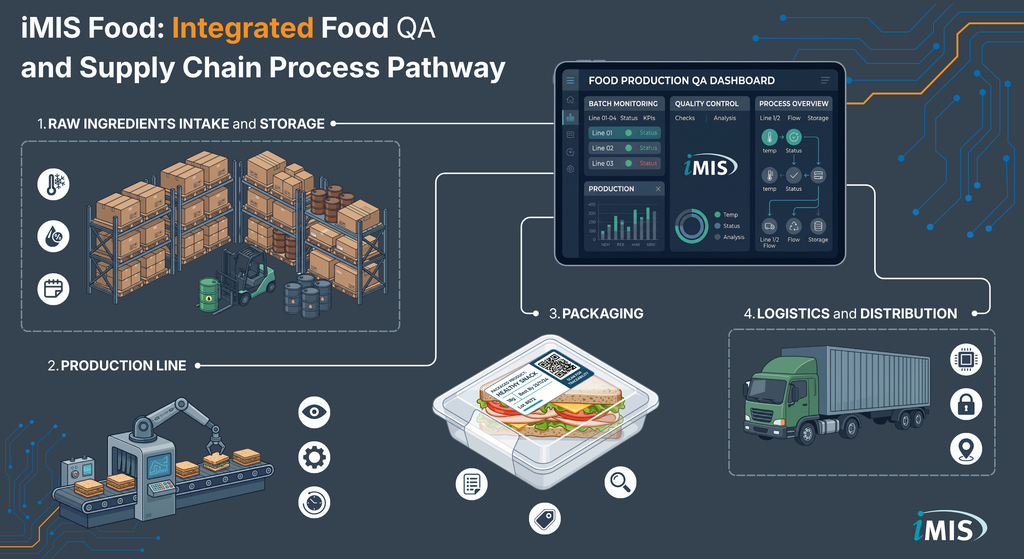
Moving Beyond Fragmented Food Safety Compliance
Food manufacturers frequently manage quality assurance through fragmented channels: isolated spreadsheets, static document shares, disconnected ERP modules, and the institutional memory of individual QA managers.
This disconnected model creates systemic vulnerabilities:
- Silent regulatory drift: regulatory updates (e.g., changes in maximum residue levels or allergen thresholds under Regulation (EU) No 1169/2011) fail to propagate dynamically to active recipes and spec sheets.
- Audit scramble: proving compliance requires days of manually compiling data rather than accessing an audit-ready, real-time single source of truth.
- Siloed operational data: in-line inspection logs, metal detector checks, and laboratory micro-results live separately from the central HACCP plan.
Connecting a generic LLM to a folder of static documents via standard retrieval-augmented generation (RAG) does not solve this. Text retrieval is not assurance. True product assurance demands structured relationships, clear ownership, defined operational limits, verifiable evidence, and closed-loop corrective actions.
The SKOA Framework: Context-Engineered Intelligence
To deliver dependable insights without algorithmic hallucination, iMIS Food organizes company intelligence through the proprietary SKOA model. This framework provides the exact relational schema AI requires to perform deterministic compliance checks:
- Structure: maps your complete organizational blueprint—site layouts, process lines, designated roles, equipment hierarchies, raw material libraries, finished goods matrices, and regional statutory scopes.
- Knowledge: codifies the technical and legal rationale behind your controls. It dynamically links food regulations, customer-specific codes of practice, GFSI requirements, biological/chemical/physical hazard databases, and vulnerability assessments (VACCP/TACCP).
- Operations: connects real-time plant floor activities to your food safety plan. This includes daily sanitation verification, CCP logging, environmental monitoring swabs, supplier intake inspections, traceability runs, and non-conformance records.
- Assurance: continuously tests whether operations align with design. It automates validation protocols, internal audit schedules, trend analyses, supplier performance scoring, and management reviews.
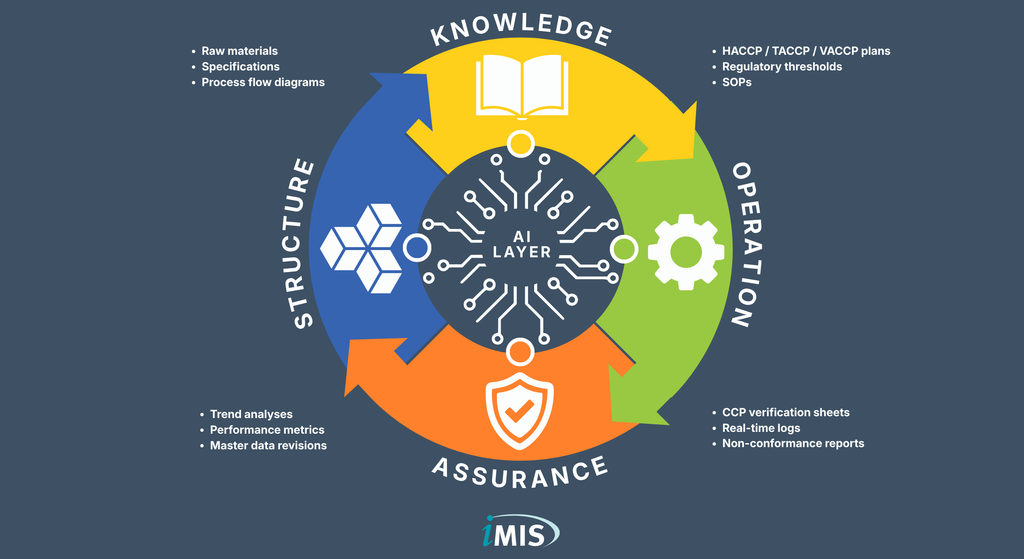
By embedding AI within the SKOA architecture, the system does not simply generate generic prose. It recognizes that if an in-line pasteurization temperature dips below critical limits for 42 seconds, it must instantly identify affected lot codes, flag linked customer specifications, initiate a non-conformance ticket, and draft the required regulatory disposition—keeping QA teams in complete control.
Intelligent Product Lifecycle Management with SpecCheck
True product integrity begins upstream in formulation, long before a product reaches the packaging line.
Through SpecCheck, iMIS Food integrates food safety, allergen management, and regulatory compliance directly into the product development lifecycle:
- Automated recipe auditing: Flags emerging allergen declarations, recalculates nutritional panels in real time, and checks ingredients against active novel-food or additive limits (e.g., Regulation (EC) No 1333/2008).
- Supplier specification sync: Automatically traces raw material changes directly to finished product specifications, eliminating version errors between procurement, NPD, and QA.
- Multi-retailer portal integration: Generates validated, audit-ready data sets formatted for major retailer portals without tedious manual re-entry.
Digital Product Passports: Real-Time Food Safety Trust, NOT Static PDFs
The European Union’s push toward circularity and traceability through the Ecodesign for Sustainable Products Regulation (ESPR) is transforming product transparency. A modern Digital Product Passport (DPP) cannot remain a static webpage or a manually exported PDF attached to a QR code.
Within iMIS Food, the Digital Product Passport is a live output of the product assurance system:
- Direct data lineage: Dynamic data—such as country of origin, audited carbon footprint, batch-level compliance status, packaging recyclability, and allergen alerts—flows directly from verified production and QA records.
- Granular access governance: Protect sensitive intellectual property by defining distinct access tiers: public transparency data for consumers, full traceability data for retail partners, and regulatory compliance dossiers for competent authorities.
- Real-time updates: If a batch specification updates or an ingredient sourcing path shifts, the live DPP reflects that change instantly across the supply chain.
Sovereign and Local AI: Complete Control Over Proprietary IP
Food and beverage manufacturers handle sensitive, commercially vital intellectual property: proprietary formulations, production line parameters, supplier pricing, microbiological challenge test results, and incident logs.
Transmitting proprietary knowledge to third-party multi-tenant cloud models presents unacceptable data exposure risks. iMIS Food is engineered for data sovereignty:
- Local and private infrastructure deployment: Run AI models locally on your private cloud, sovereign European infrastructure, or fully on-premise servers.
- Strict data isolation: Your proprietary recipes, operational workflows, and audit histories are never utilized to train external or public foundation models.
- Compliance with emerging AI governance: Designed in alignment with the EU AI Act, ensuring transparent data pipelines, explainable outputs, and auditable risk-management protocols.
You retain absolute ownership and control over your digital knowledge assets.
Related Reading: Wondering where your plant’s software falls under new European regulations? Read our complete breakdown in The EU AI Act and Food Safety: Compliance Guide to see how phased enforcement, risk tiers, and governance obligations apply across the agrifood sector.
Human-in-the-Loop: Verification Remains Paramount in Food Safety
AI accelerates cross-referencing, flags non-conformances, and automates high-volume documentation tasks. However, it cannot—and should not—replace professional human oversight.
Food safety culture depends on the accountability and expertise of plant managers, technical directors, and laboratory analysts. iMIS Food uses AI to augment human decision-making, not automate it blindly. The system presents contextualized insights, identifies discrepancies, and recommends corrective paths, but final sign-off, risk evaluations, and compliance releases remain firmly in the hands of qualified professionals.
365 Days of Continuous Food Safety
Audit readiness should not be a frantic annual event. It should be the natural consequence of daily, verified operations.
iMIS Food delivers an AI-native ecosystem built on clear structural context, sovereign infrastructure, and live compliance monitoring. By connecting organizational knowledge directly to factory operations, food businesses can protect their intellectual property, eliminate blind spots, and guarantee uncompromised product safety every single day.
Ready to transition from static documentation to continuous product assurance?
Sources
- Tajkarimi, M. (2020). Food Safety and Quality Data Management Using Artificial Intelligence. Food Protection Trends, 40(6), 464–471.
- Mavani, N. R., Ali, J. M., Othman, S., Hussain, M. A., Hashim, H., & Rahman, N. A. (2022). Application of Artificial Intelligence in Food Industry—a Guideline. Food Engineering Reviews, 14(1), 134–175.
- Barnett, S., Kurniawan, S., Thudumu, S., Brannelly, Z., & Abdelrazek, M. (2024). Seven Failure Points When Engineering a Retrieval Augmented Generation System. Proceedings of the IEEE/ACM 3rd International Conference on AI Engineering (CAIN).
- Val, I. L. (2025). The EU AI Act and the Food System: How the European Union AI Act Applies to Agrifood. European Journal of Risk Regulation, 1–21.
- Food and Agriculture Organization (FAO). (2023). Thinking About the Future of Food Safety: A Horizon Scanning Report on Emerging Digital Technologies. Rome: FAO.
Stay Connected: Join the iMIS Newsletter!
Ready to learn more? Subscribe to our newsletter for the latest updates, tips, and exclusive content delivered straight to your inbox!
Related articles to Why Most AI Tools Fail a Food Safety Audit — and What Actually Works
Many customers and visitors to this page 'Why Most AI Tools Fail a Food Safety Audit — and What Actually Works ' also viewed the articles and manuals listed below: